2026 Topps Chrome Football: What This Release Signals for the Hobby—and Why Tracking Matters More Than Ever
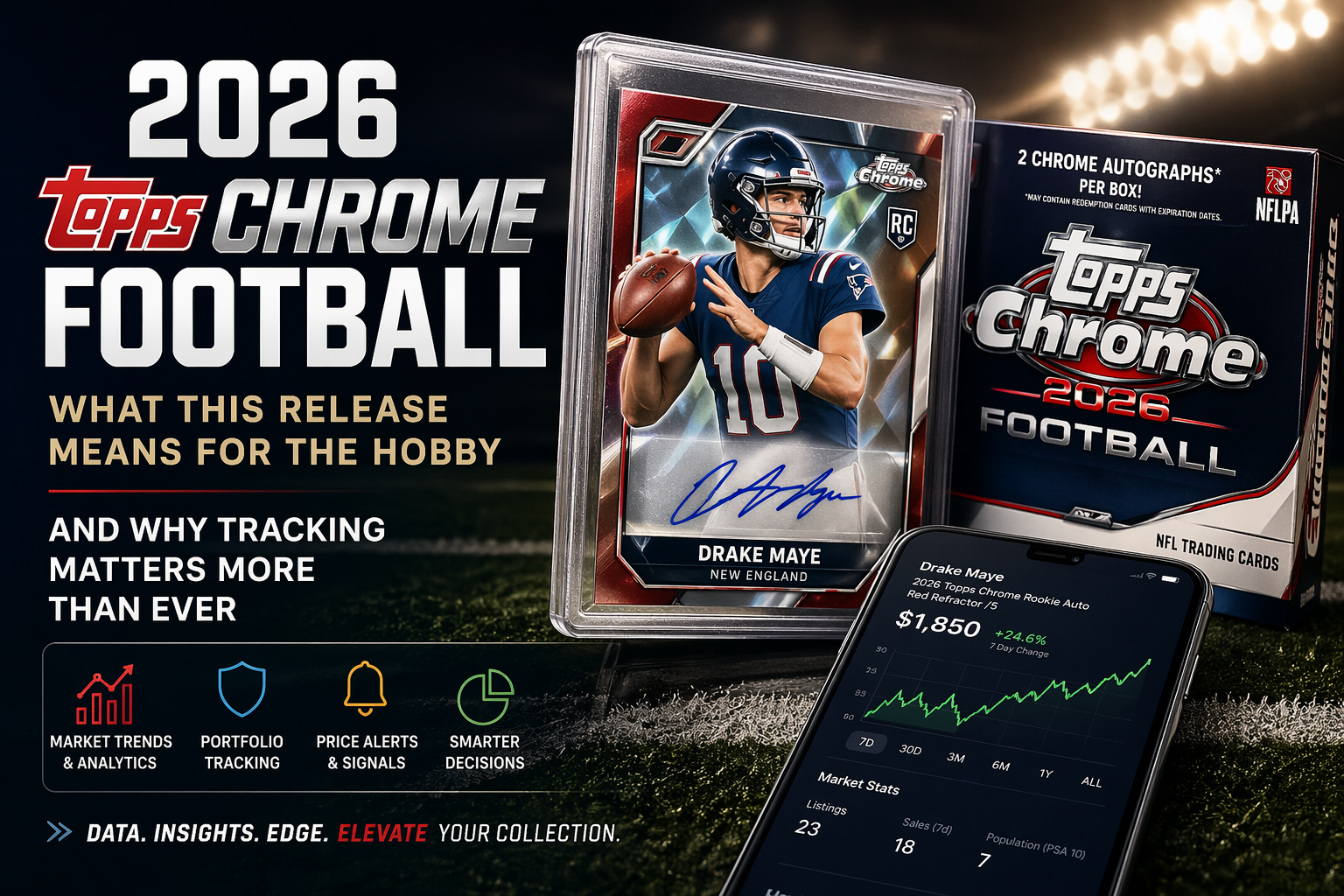
2026 Topps Chrome Football: What This Release Signals for the Hobby—and Why Tracking Matters More Than Ever
The return of Topps Chrome Football 2026 is not just another product launch. It is a major shift in the football card market and a meaningful moment for collectors, flippers, and investors trying to understand where the hobby is heading next. As the 2026 Topps Chrome Football release hits the market, it creates more supply complexity, more price volatility, and more need for real-time data. That is exactly why using a sports card tracking app makes more sense than ever.
For years, collectors could rely on instinct, player hype, and a few sold listings to judge value. That model no longer scales. Modern releases like Topps Chrome Football create dozens of refractors, parallels, inserts, autos, and short prints for the same player. If you are serious about sports card investing, football card collecting, or building a profitable collection, you need better tools.
The Context: Why 2026 Topps Chrome Football Matters
The Topps Chrome Football return carries weight because Chrome is one of the most recognized brands in the hobby. It represents premium design, strong collector interest, and historically high liquidity. When a product with that level of brand equity enters or re-enters the football card market, it does more than create excitement. It changes market behavior.
| Variable | Impact on Market |
|---|---|
| Brand equity of Topps Chrome | Creates immediate collector demand and strong perceived value |
| Licensing and product competition | Changes how collectors split attention and spending |
| Print runs and parallels | Increases supply complexity and pricing confusion |
| Rookie class strength | Drives early hype, box demand, and singles movement |
| Breaker and resale ecosystem | Accelerates price discovery and short-term volatility |
This is why the 2026 football card release calendar matters beyond wax ripping. When Chrome lands, people do not just buy boxes. They buy narratives around rookies, parallels, scarcity, and upside. That means the market reacts quickly and often irrationally, especially during release week.
Cards Are No Longer Just Collectibles. They Are Micro-Markets.
One of the biggest mistakes in the hobby is treating all cards of a player as if they move together. They do not. In the modern card market, every card is its own micro-market with its own supply, demand, liquidity, and volatility profile.
- Base rookies often have high supply and high liquidity but weaker margins
- Color parallels can become momentum-driven flip targets
- Numbered cards may have scarcity but not always enough demand depth
- Autographs and patches often trade on story, status, and collector preference
- SSPs and case hits can be powerful assets but may be harder to move
This matters for anyone evaluating Topps Chrome rookie cards, football card parallels, or long-term sports card investment opportunities. You are no longer just buying a player. You are buying a specific market inside that player’s broader market.
Why the 2026 Topps Chrome Football Release Increases the Need for Tracking
1. Supply fragmentation is growing fast
The modern sports card market is flooded with variation. A single player can have base, silver, multiple color refractors, numbered parallels, image variations, inserts, autos, and rare case hits. If you do not have a good sports card tracker, it becomes difficult to know what actually matters.
Tracking helps answer questions like:
- Which parallels are actually selling consistently?
- Which cards are getting listed constantly but not moving?
- Where are price floors forming after the initial hype fades?
- Which cards have low pop appeal but weak liquidity?
2. Release week volatility is brutal
The typical Topps Chrome Football release cycle is predictable in one sense: hype drives early spikes, then supply rushes in and prices correct. But the exact timing and severity of those moves vary by player, card type, and market demand.
| Phase | Typical Behavior |
|---|---|
| Release week | Low supply and high hype cause aggressive early pricing |
| Weeks 2 to 4 | Singles flood the market and prices often fall sharply |
| Stabilization period | True demand begins to separate strong cards from weak ones |
If you are trying to time buys or sales, this is where a sports card portfolio tracker becomes extremely valuable. It lets you stop reacting emotionally and start responding to actual trend data.
3. Liquidity matters more than headline value
A card is not truly valuable if it is difficult to sell. That is one of the biggest lessons modern collectors learn the hard way. Some football cards look expensive because of a few outlier sales or inflated listings, but once you try to exit, the demand may not be there.
Tracking tools help monitor:
- Sales velocity
- Listing-to-sale ratios
- How often a card actually transacts
- Whether buyers are paying auction prices or just sitting on BIN listings
In a product like 2026 Topps Chrome Football, where some cards will be everywhere and others will be quietly scarce, liquidity becomes one of the most important signals in the hobby.
Why Investing in a Sports Card Tracking App Makes More Sense Than Ever
The hobby has now reached the point where manual tracking is not enough. Spreadsheets can help, but they break down as your collection grows and as the market moves faster. A true sports card tracking app can centralize data, reveal trends, and help you make better decisions across your collection.
| Capability | Why It Matters |
|---|---|
| Portfolio tracking | Shows total collection value, cost basis, gain or loss, and exposure by player or card type |
| Price history | Separates noise from real market direction |
| Market scoring | Helps compare players, cards, and opportunities objectively |
| Volatility indicators | Helps identify risky cards and better entry points |
| Liquidity metrics | Reduces the chance of getting trapped in illiquid assets |
The right card tracking app does more than log what you own. It becomes an operating system for your collection. It tells you where your money is concentrated, which cards are trending up or down, and when you may need to hold, sell, or add more.
The Real Edge Is Not More Cards. It Is Better Information.
A lot of collectors still operate based on gut feel, player fandom, social media chatter, and isolated comps. That creates inefficiency. And inefficiency creates opportunity for anyone using better data.
With the right tracking system, you can start thinking in terms of:
- Accumulation opportunities when demand rises before prices fully react
- Exit signals when listings expand faster than sales
- Risk controls when volatility gets too high
- Capital allocation based on market quality, not just player popularity
This is where the hobby is going. The next winners in sports cards will not simply be the people who bought the right names. They will be the people who understood the market structure earlier and used better tools to act on it.
What the 2026 Topps Chrome Football Release Means for the Hobby
The biggest takeaway from the Topps Chrome Football 2026 release is that the hobby is becoming more financial in behavior, even if many participants still describe it as collecting. More products, more parallels, more data, and more speculation are turning cards into dynamic assets rather than static memorabilia.
That means:
- The gap between casual collectors and data-driven investors will widen
- The value of market intelligence tools will continue to increase
- Portfolio management will become a core part of serious collecting
- Collectors who track market movement will outperform those who rely only on instinct
In that environment, using a sports card collection app or sports card investment app is not just convenient. It is strategic.
Final Thoughts
The 2026 Topps Chrome Football release is a signal that the hobby is continuing to evolve into a faster, more complex, and more data-dependent market. For collectors, flippers, and investors, this means one thing very clearly: tracking matters more than ever.
If you want to compete in a market shaped by scarcity, supply pressure, liquidity, and hype cycles, you need more than screenshots and memory. You need a real system. And that is exactly why investing in a sports card tracking app makes more sense now than it ever has before.