The 5 Best Rookie Cards to Buy Now for Under $500
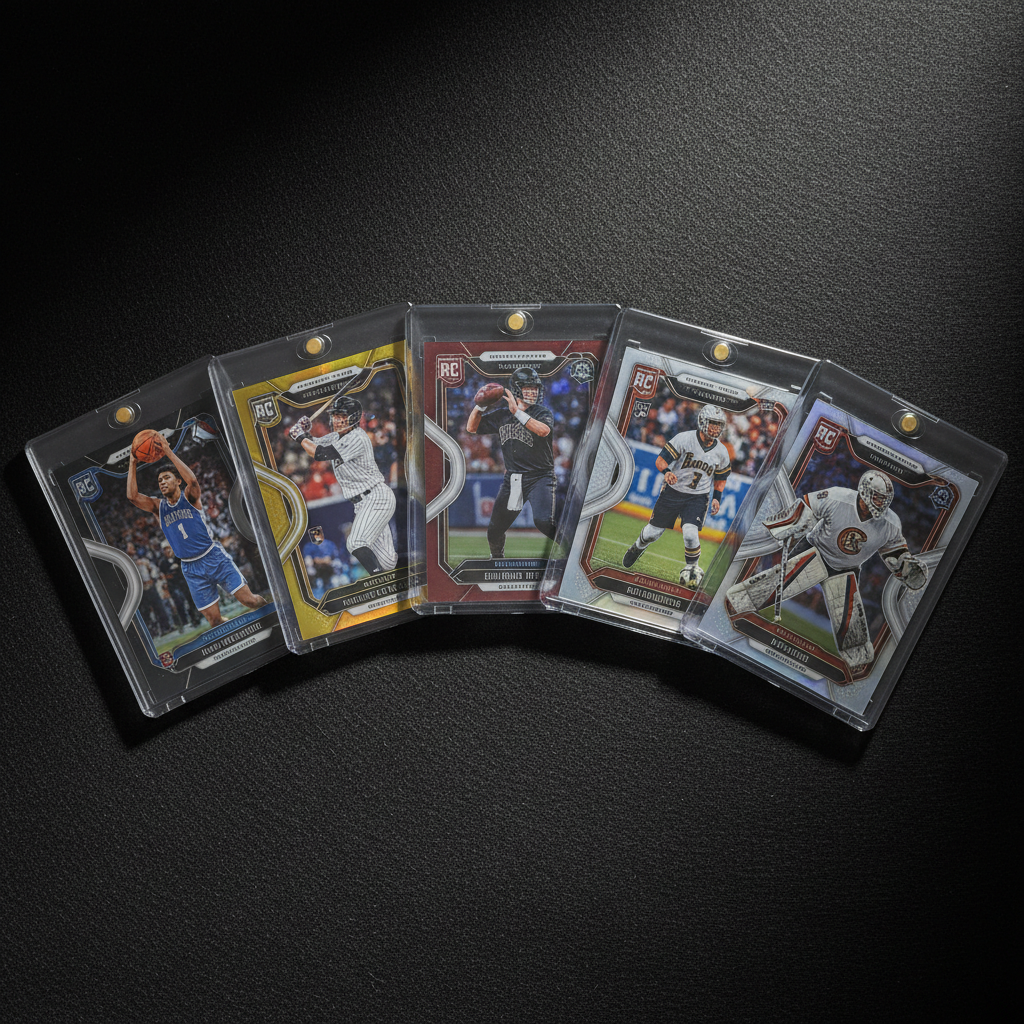
For the serious collector, the sub-$500 rookie card market is the single best allocation of capital for balancing high-upside potential with a reasonable cost basis. This guide is not for flippers chasing fleeting trends; it’s for collectors building a portfolio of iconic cards with demonstrable long-term value. We analyzed hundreds of cards, focusing on players who are not just athletes but brands, whose rookie cards are benchmarks in their respective sports. Our methodology prioritizes liquidity, graded population relative to demand, and the player’s projected historical significance. The key takeaway is this: you can acquire cornerstone cards of generational talents for under $500 if you buy the right card at the right grade.
How We Picked
- Player Ceiling & Potential
- Card Liquidity & Demand
- Graded Population & Scarcity
- Affordability & Value
- Historical Significance
At a Glance
| Rank | Pick | Best For | Price Range |
|---|---|---|---|
| 1 | 1989 Upper Deck Ken Griffey Jr. Star Rookie #1 | The collector who wants a blue-chip, historically significant asset that forms the foundation of a serious portfolio. | $50-$90 raw, $300-$450 PSA 9 |
| 2 | 2020 Panini Prizm Anthony Edwards #258 | The growth-oriented investor willing to bet on elite talent in a high-demand, liquid market. | $40-$60 raw, $100-$150 PSA 9 |
| 3 | 2022 Topps Update Julio Rodriguez #US44 | The collector who wants a high-grade, low-cost card of an elite baseball talent. | $10-$20 raw, $80-$120 PSA 10 |
| 4 | 2023 Panini Prizm C.J. Stroud #339 | The high-risk, high-reward investor looking to capitalize on the NFL's quarterback premium. | $80-$120 raw, $200-$250 PSA 9 |
| 5 | 2019 Topps Chrome UEFA Champions League Bukayo Saka #64 | The forward-thinking investor looking for international appeal and scarcity in a rapidly growing category. | $80-$150 raw, $300-$400 PSA 10 |
1. 1989 Upper Deck Ken Griffey Jr. Star Rookie #1
The most important baseball card of the modern era.
This isn't just a baseball card; it's a cultural touchstone that ignited the modern hobby. Despite a high print run, demand is perpetual and global. A PSA 9—a visually pristine copy—is readily available in the $300-$450 range, offering a stable, liquid asset that is a cornerstone of any serious collection. Its value is driven by nostalgia and historical importance, insulating it from the volatility of modern player performance.
Best for: The collector who wants a blue-chip, historically significant asset that forms the foundation of a serious portfolio.
Price range: $50-$90 raw, $300-$450 PSA 9
Pros
- Arguably the most iconic card of the last 40 years.
- Extremely liquid and easy to trade or sell.
- Holds value well during market downturns.
Cons
- High population in PSA 9 (over 80,000).
- Limited short-term upside compared to modern players.
2. 2020 Panini Prizm Anthony Edwards #258
The premier rookie card of basketball's most explosive rising star.
Anthony Edwards has emerged as a legitimate superstar with a game and personality built for the global stage. His Prizm rookie is his key, benchmark card from the NBA's flagship chrome set. While a PSA 10 has breached the $500 barrier, clean raw copies and PSA 9s are an absolute bargain. With a PSA 10 population under 15,000, it's far scarcer than previous #1 pick Prizm rookies. Buying a PSA 9 for under $150 is a calculated investment in a player on a clear Hall of Fame trajectory.
Best for: The growth-oriented investor willing to bet on elite talent in a high-demand, liquid market.
Price range: $40-$60 raw, $100-$150 PSA 9
Pros
- Benchmark rookie of a Tier-1 superstar.
- Prizm is the most liquid modern basketball brand.
- Relatively scarce for a modern #1 pick's flagship rookie.
Cons
- Value is tied to on-court performance and health.
- Base Prizms can be seen as generic compared to rarer parallels.
3. 2022 Topps Update Julio Rodriguez #US44
A future classic from baseball's most important set.
Julio Rodriguez is a 5-tool superstar and the face of the Seattle Mariners. His Topps Update rookie is his most accessible and recognizable flagship card. The key here is the grading economics: While the card is plentiful, so is the demand. A PSA 10 is trading comfortably in the $80-$120 range, making it the perfect 'buy the grade' acquisition. It offers direct exposure to a top-5 young player in MLB at a price point that is almost impossible to beat.
Best for: The collector who wants a high-grade, low-cost card of an elite baseball talent.
Price range: $10-$20 raw, $80-$120 PSA 10
Pros
- Extremely affordable for a PSA 10 of a major star.
- Part of the Topps flagship line, a collector favorite.
- High liquidity and trading volume.
Cons
- High population in PSA 10 (over 35,000).
- Print run is substantial, limiting long-term scarcity.
4. 2023 Panini Prizm C.J. Stroud #339
The key rookie card for the NFL's next elite quarterback.
After one of the greatest rookie QB seasons in NFL history, C.J. Stroud has set a new benchmark for potential. His base Prizm rookie is the single most traded card for the NFL's hottest young player. While prices were volatile during the season, the offseason provides a buying window. A well-centered raw copy can be had for under $100, while a PSA 9 slab offers a graded entry point for around $200-$250. This is the highest-risk, highest-reward pick in the guide, but the upside is a top-3 QB in the league.
Best for: The high-risk, high-reward investor looking to capitalize on the NFL's quarterback premium.
Price range: $80-$120 raw, $200-$250 PSA 9
Pros
- Massive hype and market attention on a franchise QB.
- Prizm is the benchmark rookie card for modern football.
- Potential for significant price growth if he continues his elite play.
Cons
- Extreme volatility based on performance and hype cycles.
- High raw card prices make grading a risky proposition.
- Pop report is still growing, final numbers are unknown.
5. 2019 Topps Chrome UEFA Champions League Bukayo Saka #64
The undervalued rookie of a global soccer icon.
Soccer cards offer exposure to the world's largest collector base, and this card is a prime, undervalued asset. Bukayo Saka is a top-tier player for both Arsenal and England. His 2019 Topps Chrome rookie is from a major, premium set and has a surprisingly low PSA 10 population of just over 1,100. For under $400, you can acquire a PSA 10 of a global superstar whose market has not yet caught up to his peers, offering significant room for growth as the soccer market matures.
Best for: The forward-thinking investor looking for international appeal and scarcity in a rapidly growing category.
Price range: $80-$150 raw, $300-$400 PSA 10
Pros
- Relatively low PSA 10 population creates scarcity.
- Exposure to the massive international soccer market.
- Player is an established superstar on a major club.
Cons
- Soccer card market can be less liquid in the US than the big 3 sports.
- Player's club performance heavily influences value.
How to Buy
'''
How to Buy Smart in the Sub-$500 Market
1. Where to Source Your Cards:
- eBay: The primary marketplace. Use the "Sold Items" filter to research real-time market prices before buying. Stick to sellers with 1,000+ feedback and a 99.5% or higher rating.
- MySlabs: A fixed-price marketplace with lower fees than eBay, often resulting in better prices for graded cards. It's a go-to for experienced collectors.
- COMC (Check Out My Cards): Best for sourcing raw cards. You can buy cards and have them stored in a port, or have them shipped directly to PSA for grading. It's an excellent way to find undervalued raw copies.
2. Raw vs. Graded - The Economic Equation:
In the sub-$500 space, this is the most critical decision.
- Buy Graded (PSA 9/10): When the price of the graded card is less than the cost of a clean raw card plus grading fees (~$25-$35). The Julio Rodriguez PSA 10 is a perfect example. You get certainty and a liquid asset for a fair price.
- Buy Raw (and potentially grade): When you believe you can "gem" the card (i.e., it will receive a PSA 10). A rule of thumb is the PSA 10 value should be at least 3-4x the cost of your raw card to be worth the risk and effort. Before buying raw online, ask for high-resolution photos of all four corners and the surface under direct light.
3. Essential Tools & Diligence:
- PSA Population Report: Before buying any graded card, look it up on the PSA website. Understand how many cards exist in that grade and higher. This is your primary tool for evaluating scarcity.
- Magnifying Loupe: If you buy raw cards, a 10x jeweler's loupe is a non-negotiable tool for inspecting corners and edges for even the smallest flaws.
4. Common Pitfalls to Avoid:
- Ignoring Shipping Costs: A $40 card with $20 shipping is a $60 card. Factor all costs into your buying decision.
- FOMO (Fear Of Missing Out): Don't buy a player's card when it's spiking due to a big game. Wait for the market to cool and prices to stabilize. The offseason is often the best time to buy.
- Not Vetting the Seller: Check feedback, look at what else they sell, and never, ever buy from someone with a shaky reputation to save a few dollars. '''
Frequently Asked Questions
Is a PSA 9 a good investment?
Absolutely. For many blue-chip cards, the PSA 10 is financially unattainable for most collectors. A PSA 9 represents a card in pristine condition to the naked eye and often trades at a significant discount—sometimes 50-80% less—than a PSA 10. It is the single best way to own an iconic card in a high-quality, liquid, and encapsulated form without overextending your budget.
Why isn't Shohei Ohtani or Victor Wembanyama on this list?
While both are generational talents, their key rookie cards (e.g., 2018 Topps Chrome Ohtani, 2023 Panini Prizm Wembanyama) in PSA 9 or 10 condition currently trade well above the $500 threshold, placing them in a different investment category. This guide focuses specifically on rookie cards that are accessible for under $500 right now.
What's the difference between Topps Update, Topps Chrome, and Panini Prizm?
Topps Update is a flagship paper set, considered the standard-bearer for traditional baseball card collecting. Topps Chrome (for baseball/soccer) and Panini Prizm (for basketball/football) are premium sets printed on chromium card stock, giving them a metallic shine and higher perceived value. Prizm and Chrome are generally considered the 'benchmark' rookie cards in the modern hobby.
How much does it cost to get a card graded by PSA?
Prices fluctuate based on demand and the declared value of the card. As of 2024, the most common service level for cards in this price range costs approximately $25 per card through a PSA membership or an authorized dealer. Expect turnaround times of 2-3 months at this level.