How to Tell If a Player’s Card Market Is Overheated
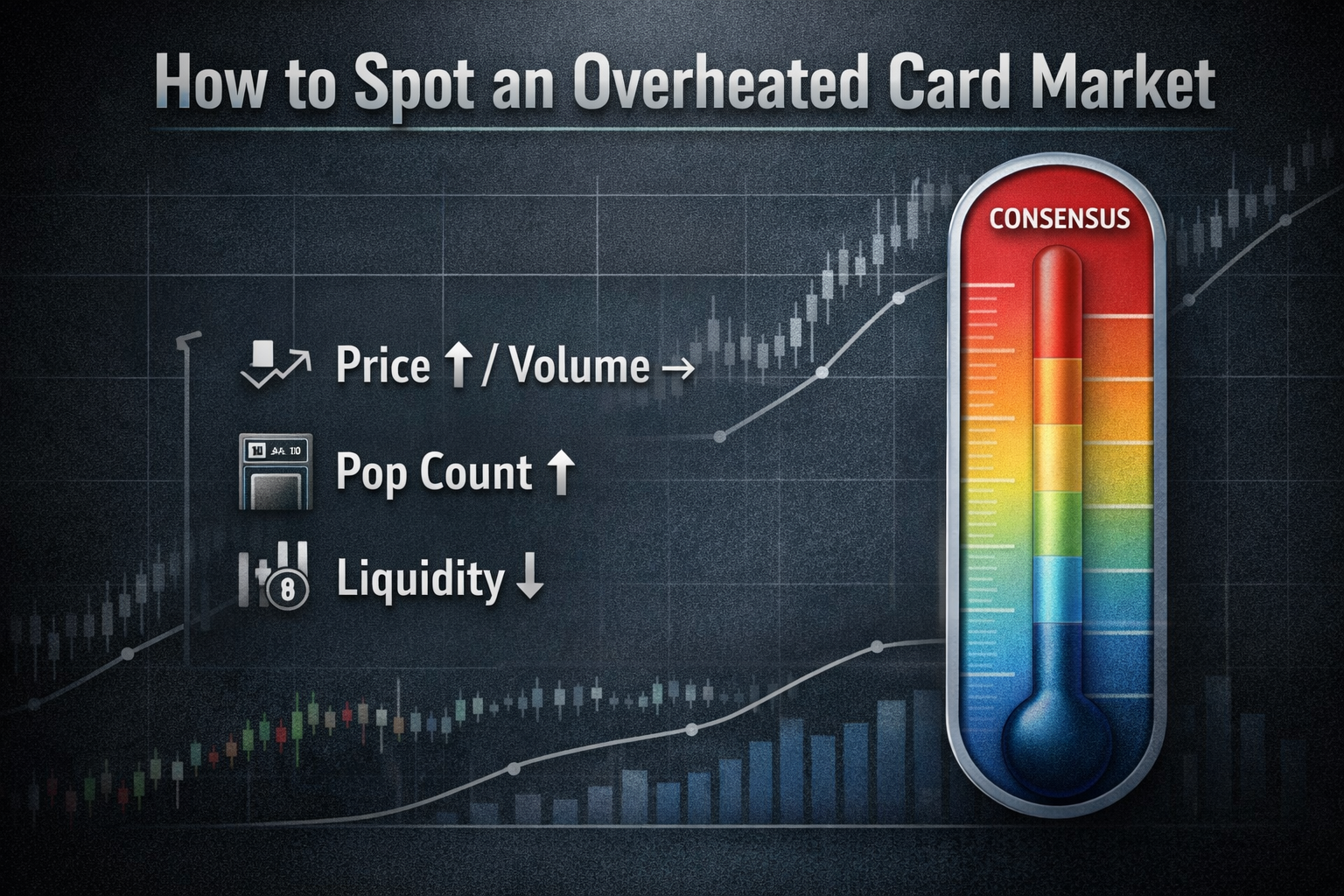
The signals most collectors miss until it’s too late
Most collectors don’t lose money because they picked bad players. They lose money because they bought good players at the wrong moment.
An overheated card market doesn’t feel risky. It feels obvious. Prices are rising, comps look strong, and everyone agrees the player is “the real deal.” That’s usually when the danger is highest.
Here’s how to tell when a player’s card market is overheated—before the correction shows up in your collection.
⸻
- Price Is Rising Faster Than Volume
Healthy markets rise with participation. Overheated markets rise with fewer transactions.
If prices are climbing but the number of completed sales is flat or declining, price discovery is being driven by a small number of aggressive buyers. That’s fragile.
Once those buyers stop bidding, there’s no depth underneath the price.
This is one of the earliest warning signs—and one of the easiest to miss.
⸻
- PSA 10 Population Is Accelerating Into the Hype
Grading doesn’t create demand. It concentrates it.
When hype hits, grading submissions surge. PSA 10 populations grow right as collectors are extrapolating scarcity from outdated data. By the time those new slabs return, supply quietly overwhelms demand.
This is why many PSA 10 charts peak months after the player’s on-field breakout.
Population growth doesn’t kill markets instantly. It erodes them slowly—then all at once.
⸻
- Narrative Has Shifted From “Upside” to “Validation”
Early demand is fueled by possibility. Late demand is fueled by confirmation.
When coverage shifts from: “Could this player be great?” to: “See, we were right.”
The market is maturing—and approaching saturation.
Once a narrative becomes consensus, new buyers dry up. The story is already priced in.
⸻
- Comps Are Clustering at Identical High Prices
In healthy markets, sales form a range.
In overheated markets, comps stack at the same number: • Same price • Same timeframe • Same card
This often signals: • Anchoring • Fear of missing out • Short-term speculation
When price variety disappears, volatility increases.
⸻
- Liquidity Drops While Prices Hold
This is the most dangerous phase.
Prices look stable, but listings sit longer. Sales slow. Sellers undercut quietly. The chart hasn’t rolled over yet—but the market is already weakening.
By the time price visibly drops, liquidity has usually collapsed first.
Price reacts last.
⸻
Why Overheated Markets Hurt So Much
Corrections don’t happen because players fail. They happen because expectations peak.
Once upside is fully priced in, the market needs something extraordinary to move higher. “Very good” is no longer enough.
This is why even elite seasons sometimes produce flat—or declining—card prices.
⸻
How This Ties Back to Sportscardportfolio
At Sportscardportfolio, we focus on market signals, not hype cycles.
Price trends, transaction frequency, volatility, and supply pressure tell you when risk is rising—often before sentiment shifts.
Overheated markets are identifiable. You just have to look past the highlights.
⸻
The Bottom Line
If a market feels safe because everyone agrees, it’s probably not.
The best buying opportunities feel uncomfortable. The worst ones feel obvious.
Understanding the difference is the edge.