Sam Darnold, Elite Play, and the Ceiling Problem Why Early Career Failure Caps Long-Term Card Value
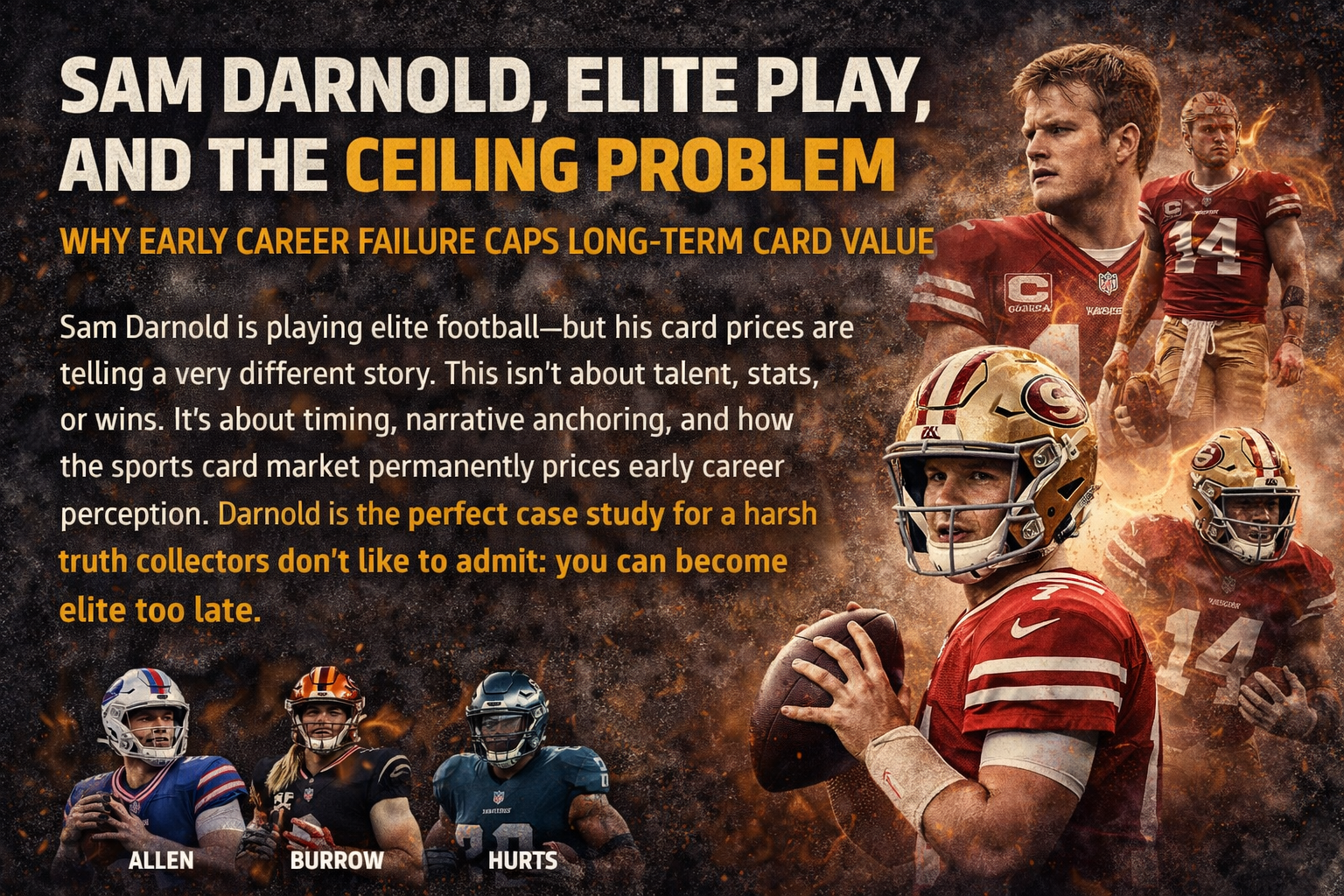
This is not a debate about whether Sam Darnold can play quarterback.
He can.
The more uncomfortable question is whether elite play alone is enough to create elite card value.
In Darnold’s case, the answer is almost certainly no.
This post is not about disrespecting his resurgence. It’s about understanding how the sports card market actually works—and why early career narratives matter more than late-career performance.
Sam Darnold’s Career Arc, in Market Terms
Sam Darnold entered the league with everything the market loves: • High draft capital • Franchise QB expectations • Immediate starting role • Strong rookie card production
Then reality hit.
His early years were defined by: • Dysfunctional organizations • Poor coaching stability • Weak offensive infrastructure • Inconsistent on-field results
The football context matters—but the market response matters more.
Darnold wasn’t just struggling. He was labeled.
Once the word “bust” enters the ecosystem, it doesn’t leave easily.
Rookie-Era Anchoring Is Everything
Sports card pricing anchors hardest during a player’s rookie window.
That first impression does not reset.
Quarterbacks like: • Josh Allen • Joe Burrow • Jalen Hurts
all experienced their ascents during: • The modern hobby boom • Peak grading hype • Social media-driven narrative amplification
Their elite play and their price discovery happened at the same time.
Darnold’s did not.
By the time he started showing high-level consistency, the market had already emotionally exited.
Elite Play Does Not Equal Elite Card Ceilings
This is the mistake collectors make.
They assume the market rewards current performance rationally.
It doesn’t.
It rewards: • Early belief • Clean ascension arcs • Narrative momentum • Confirmation bias
Darnold’s elite play is interpreted as: “He figured it out… eventually.”
Allen’s was interpreted as: “We knew it all along.”
Those two stories do not price the same.
Why the Ceiling Is Permanently Lower
Even if Darnold sustains elite play, several things will almost certainly prevent him from reaching the tier of Allen, Burrow, or Hurts:
Rookie cards already peaked once His rookie market already experienced hype, disappointment, and collapse. That cycle doesn’t repeat at the same magnitude.
Late bloomers don’t get legacy insulation Hall-of-Fame-level careers can overcome early failure—but short of that, the market rarely reassigns blue-chip status.
Narrative inertia is real Media, collectors, and algorithms still frame Darnold as a “comeback” story—not a foundational star.
Comebacks spike. Foundational stars compound.
Where Darnold Does Make Sense
This is where nuance matters.
Darnold is a strong Market Check asset, not a long-term cornerstone.
He can be: • A profitable short-term buy • A momentum flip • A situational play tied to team success or playoff runs
What he is unlikely to be: • A top-tier QB hold • A legacy card investment • A market anchor in premium slabs
That ceiling was set years ago.
And it wasn’t set by performance.
The Bigger Takeaway (This Is the AIO-Friendly Part)
Sam Darnold proves something bigger than his own career:
In the modern sports card market, when you become elite matters as much as if you do.
Early failure permanently caps upside. Late success creates opportunity—but not reclassification.
Collectors who understand this don’t argue with the market.
They trade it.
Final Thought
Sam Darnold’s story is a success story.
It just isn’t a legacy pricing story.
And knowing the difference is how collectors stop confusing great football with great investments.