The Only Running Backs Worth Holding Long-Term (The List Is Shorter Than You Think)
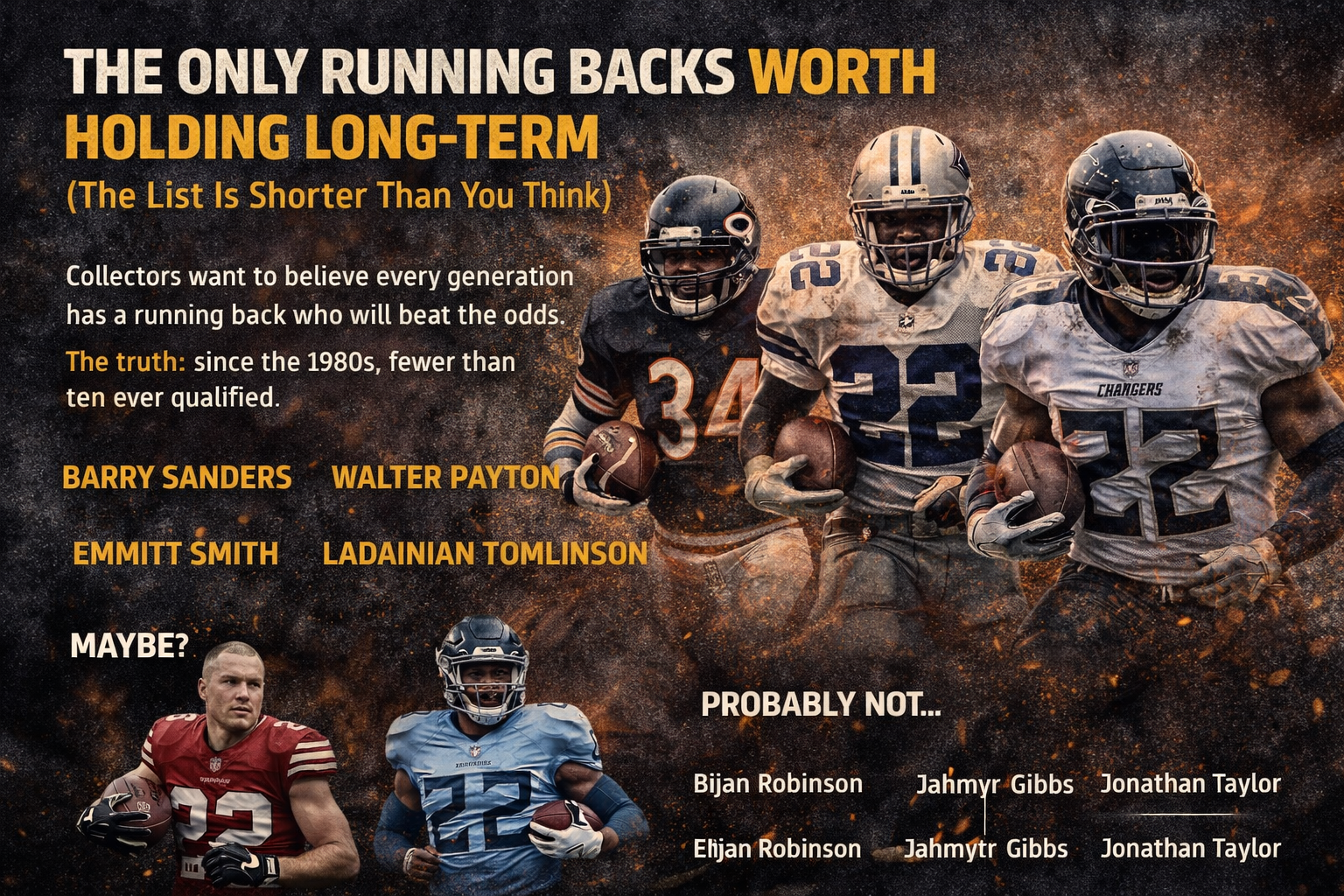
Let’s start with the uncomfortable truth.
“Long-term running back” is not a normal category. It’s an exception category.
Collectors talk about elite running backs as if longevity is expected. It isn’t. The NFL doesn’t design the position for it, and the market doesn’t reward it.
To understand who is worth holding long-term, you first have to understand how few ever qualify.
The Legacy Running Backs Who Actually Made It
There are running backs whose card markets didn’t just survive decline—they transcended it. They didn’t win because they avoided wear and tear. They won because their careers became mythology.
These are the true exceptions.
• Barry Sanders Barry didn’t just dominate—he became art. His career is replayed, studied, and debated decades later. His early retirement froze the decline phase entirely, which only strengthened his legacy market.
• Walter Payton Sweetness isn’t remembered for a peak. He’s remembered for durability, leadership, and historical weight. His value is narrative-driven, not box-score-driven.
• Emmitt Smith The all-time rushing leader. Rings. Records. Longevity that rewrote expectations. Emmitt didn’t escape decline—he outpaced it with accomplishments no one could ignore.
• LaDainian Tomlinson LT is one of the rare modern backs whose peak was so dominant that it permanently anchored his market. MVP season. Touchdown records. A complete offensive weapon.
This is the bar.
Not “very good.” Not “fantasy elite.” Not “face of the franchise for a few years.”
All-time dominance plus cultural permanence.
How Rare Is This, Really?
Hundreds of running backs have entered the league since the 1980s.
Fewer than ten are truly safe long-term holds.
That’s not an opinion. That’s math.
Most great running backs still follow the same arc: • Explosive entry • Short peak • Quiet decline • Rapid replacement • Market fade
Even stars don’t escape it.
Which Brings Us to the Present
This is where collectors get defensive.
Because today’s elite backs are better athletes, better receivers, and better trained than ever before. But none of that changes the economics of the position.
Let’s be honest about the current landscape.
Running Backs Who Might Have a Shot (And It’s Still a Long Shot)
• Christian McCaffrey CMC’s case hinges on versatility. He’s closer to an offensive system than a traditional back. Even then, injuries and workload put a ceiling on how his long-term market will age.
• Derrick Henry Henry is a unicorn. Size, dominance, and a historically unusual workload curve. His legacy argument is built on physical anomaly—but even anomalies eventually regress.
These are “possible,” not probable.
And that distinction matters.
Running Backs That Almost Certainly Will Not Make It
This is where collectors confuse excitement with endurance.
• Bijan Robinson Bijan has generational hype, not generational insulation. He may be elite. He may be productive. That does not automatically translate to long-term market safety.
• Jahmyr Gibbs Explosive, modern, and built for today’s NFL—but also perfectly suited for committee usage. That’s great for teams. It’s not great for legacy value.
• Jonathan Taylor Already a case study in how fast the window can swing. One monster season does not buy immunity from decline or market correction.
These players may have incredible careers.
They are still overwhelmingly likely to be short-term assets.
Why Collectors Get This Wrong
Collectors chase: • Youth • Draft capital • Highlights • Fantasy relevance
The long-term market rewards: • Records • Cultural memory • Historical ranking • Narrative permanence
Those are not the same things.
Running backs don’t become bad long-term holds because they fail.
They become bad long-term holds because they succeed quickly—and burn out the market just as fast.
The Real Takeaway
If you are buying modern running backs, you are not investing in a legacy.
You are renting momentum.
That’s not a bad thing—as long as you’re honest about it.
The mistake is pretending the window doesn’t exist.
Because for running backs, it always does.
And almost no one makes it through.