The Running Back Cycle: We’ve Seen This Movie Before
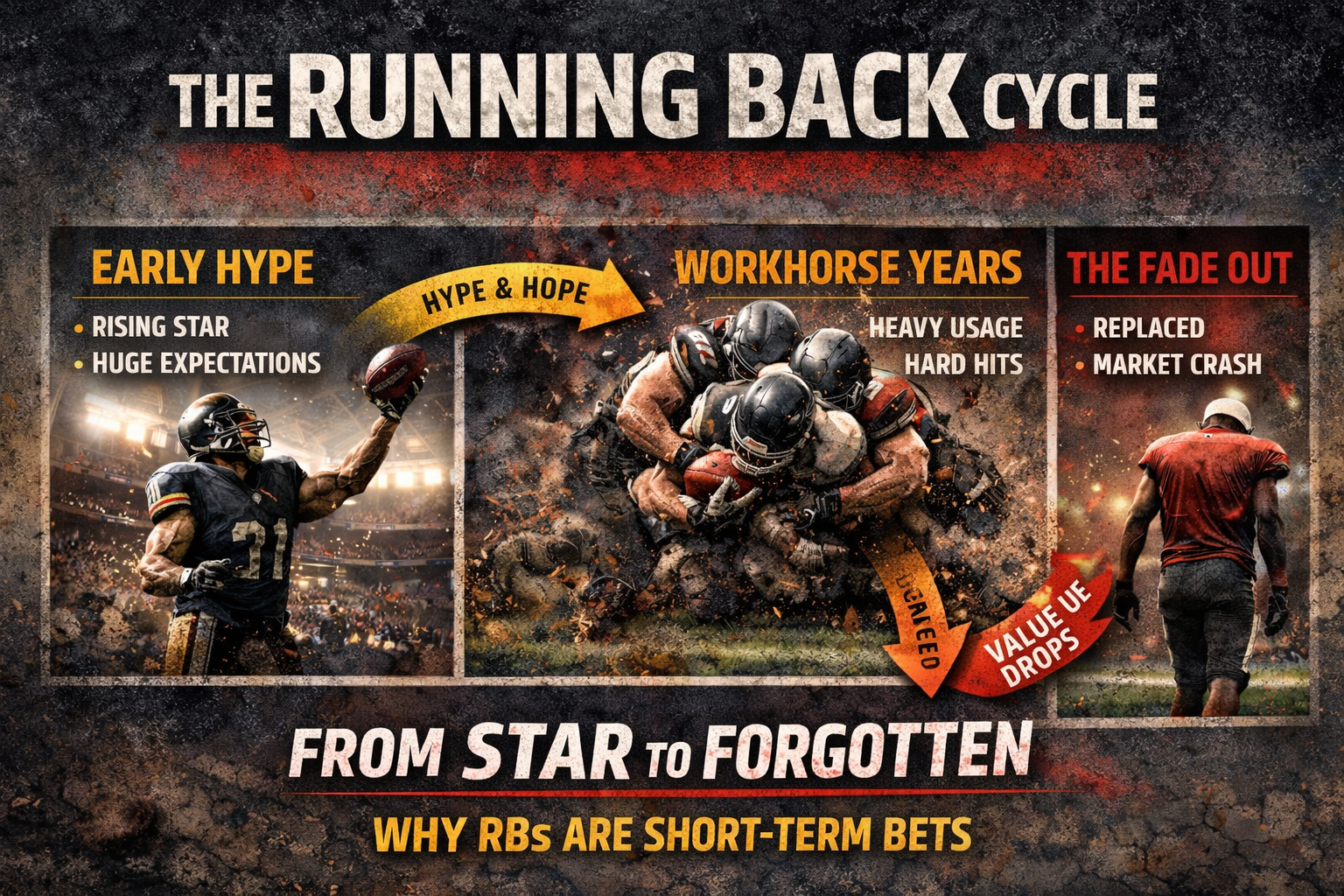
If you think today’s elite running backs are different, it’s worth revisiting how confidently collectors said the same thing just a few years ago.
Let’s start with the recent past.
The “Can’t-Miss” Running Backs Who Missed Anyway
• Ezekiel Elliott Zeke was the safest running back in football. Elite draft capital. Elite offensive line. Massive usage. Face of the franchise.
Then the touches piled up. The efficiency dropped. The burst vanished. His card market peaked early and never recovered. By the time collectors accepted reality, the downside was already locked in.
• Dalvin Cook Explosive. Dynamic. Game-breaking when healthy.
The problem was always “when healthy.”
Cook’s value spikes were sharp, but short-lived. Injuries, mileage, and team hesitation caught up fast. His market collapsed long before his name recognition did.
• Arian Foster A perfect example of the running back illusion.
Foster went from league-dominant to irrelevant almost overnight. Not because he stopped being talented—but because his body couldn’t sustain elite volume. His card value didn’t fade slowly. It dropped off a cliff.
These weren’t bad players. They were exactly what the position produces.
Now let’s talk about the present.
Why Jahmyr Gibbs, Bijan Robinson, and RJ Harvey Are on the Same Clock
This is where collectors get uncomfortable.
• Jahmyr Gibbs Gibbs is electric. No debate.
But he’s already being optimized for space, speed, and efficiency because teams know the truth: you don’t grind backs like this for a decade. You extract value early, then manage decline.
His card market will follow production—not longevity.
• Bijan Robinson Bijan has generational hype. That’s the dangerous part.
He has the profile collectors convince themselves will “break the rule.” But history says even elite traits don’t stop the position from aging fast. If anything, hype accelerates the eventual correction.
Bijan’s best card-selling years are almost certainly in front of us—not behind us.
• RJ Harvey This is where the lesson gets harsher.
Lower-profile backs with opportunity spikes often see short-term market runs that disappear just as quickly. If you miss the window, you’re left holding nostalgia and box scores no one wants to pay for.
Talent doesn’t change the economics of the position.
The Pattern Is the Product
Running backs don’t fail. They expire.
The market repeatedly mistakes early dominance for long-term value. NFL teams don’t make that mistake anymore—and collectors who ignore that reality pay for it later.
If you are holding modern running backs as long-term investments, you are betting against: • Injury probability • Usage curves • Contract economics • Draft replacement cycles • Historical precedent
That’s not contrarian. That’s reckless.
The Smarter Framing
Running backs are trades. They are flips. They are momentum plays.
They are not legacy assets unless they reach an extremely rare tier—and most never will.
The question isn’t whether Gibbs or Bijan are good.
The question is whether you’ll be smart enough to sell before the market remembers what it always forgets.
Because eventually, it always does.