Topps Chrome Parallels: A Data-Driven Investor's Guide
'''
Topps Chrome Parallels: A Data-Driven Investor's Guide
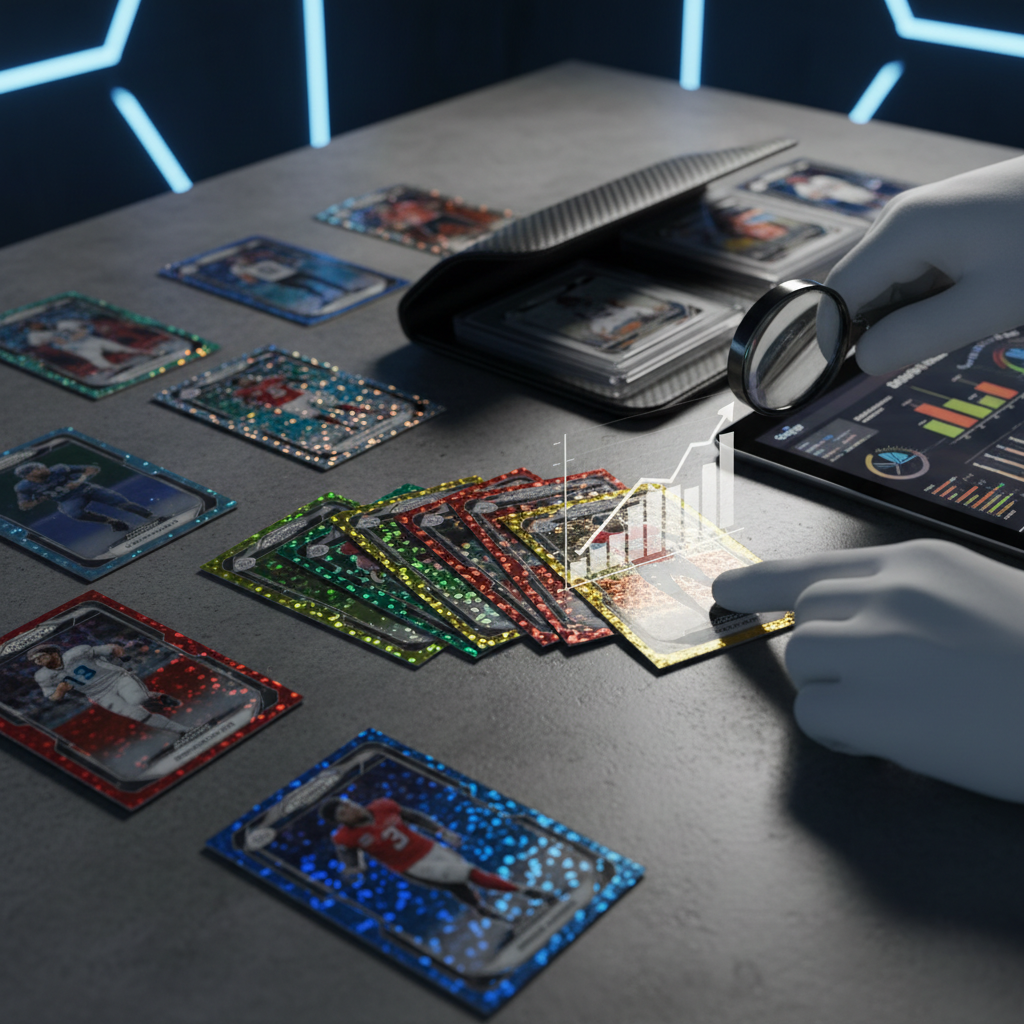
The flash of color, the glint of a refractor finish, the bold stamp of a serial number: this is the language of modern sports card investing, and Topps Chrome parallels are its most fluent dialect. For decades, the base rookie card was king. Today, the game has changed. True value lies in scarcity, and parallels are the primary vehicle for delivering it. Understanding the intricate hierarchy—the rainbow—is no longer a niche pursuit for super-collectors; it is a fundamental requirement for generating alpha in the sports card market.
This is not a simple checklist. This is a data-driven breakdown for serious investors. We will dissect the Topps Chrome parallel ecosystem, quantify the multipliers, analyze the grading economics, and provide opinionated, actionable strategies. Forget simply "collecting the rainbow"; we're here to build the most profitable part of it.
What is a Topps Chrome Parallel? The Core Concept
A parallel is a version of a standard base card that incorporates a recognizable, systematic variation. While the player, photo, and core design remain the same as the base card, parallels are distinguished by features designed to create a tiered system of rarity.
Key differentiators include:
- Refractor Finish: The baseline parallel, which uses a light-refractive coating to create a "rainbow" shine when tilted. All colored parallels are also refractors.
- Color: The most obvious differentiator. Specific colors (Blue, Green, Gold, Orange, Red, etc.) are tied to specific print runs.
- Serial Numbering: A stamp on the card (e.g., "025/100") indicating its precise, limited print run.
- Pattern: Some parallels, like the X-Fractor, use a unique pattern overlay instead of solid color.
- Image Variations: The most valuable parallels often use an entirely different photograph of the player, denoted as a Short Print (SP) or Super Short Print (SSP).
Think of the base card as common stock in a company. Parallels are like different classes of shares with varying levels of scarcity and value. As an investor, your goal is to identify which "share class" offers the optimal balance of risk, liquidity, and upside.
The Topps Chrome Parallel Hierarchy: From Common to Case Hit
Not all parallels are created equal. Their value is determined by a clear hierarchy based almost exclusively on print run. Let's break down the tiers using a real-world example: the 2023 Topps Chrome set.
Tier 1: The Foundational Refractors (High Print Run / Un-numbered)
These are the most common parallels, often found in retail formats. They are highly liquid but offer the lowest multipliers.
- Refractor: The original parallel that started it all in 1993. It forms the foundation of the Chrome ecosystem. Investor Insight: A PSA 10 standard Refractor of a top rookie is the entry point for serious player collectors. It typically trades at a 2x-4x multiplier over the base PSA 10. They are the most liquid of all parallels.
- Sepia & Pink Refractors: Retail-exclusive parallels found in Value Packs and Blaster boxes, respectively. They have massive print runs. Investor Insight: These are volume assets. The low cost makes them ideal for quick flips on hot rookies or for accumulating large quantities for grading, hoping to hit a gem mint copy. Expect a 1.5x-3x multiplier over the base PSA 10.
- X-Fractor: A hobby box staple, distinguished by its iconic checkerboard refractor pattern. Investor Insight: The X-Fractor carries more prestige than a base Refractor. It commands a slight premium, often in the 3x-5x multiplier range, due to its classic design and hobby-only distribution.
Tier 2: The Core Color Spectrum (Numbered)
This is where serious investing begins. Serial numbering provides a verifiable, fixed supply, allowing for more precise valuation. The multipliers here are exponential.
| Parallel Name | Serial Number | Typical PSA 10 Multiplier (vs. Base PSA 10) | Investor Insight |
|---|---|---|---|
| Magenta Speckle | /350 | 5x - 8x | A newer, high-number parallel. Good entry-point for numbered cards. |
| Purple | /299, /250 | 8x - 12x | A solid mid-tier color. Good liquidity. |
| Aqua Lava | /199 | 12x - 18x | The "Lava" pattern has strong visual appeal. |
| Blue RayWave | /150 | 15x - 25x | Blues are a classic, well-respected parallel tier. |
| Green | /99 | 20x - 35x | Sub-100 print runs represent a significant jump in scarcity and value. |
| Gold Refractor | /50 | 30x - 60x+ | The Investor's Standard. Gold is the most iconic and sought-after color. It offers a perfect blend of scarcity, recognition, and visual appeal. A core holding for any serious portfolio. |
| Orange Refractor | /25 | 50x - 100x+ | The "low-numbered" territory. We are now in case-hit territory. These are significant assets. |
| Red Refractor | /5 | 100x - 250x+ | Exceptionally rare. These surface for sale infrequently and command massive premiums. True trophy cards. |
| SuperFractor | 1/1 | 1000x+ | The single most valuable version of any card in the set. A market-defining asset whose sale becomes a benchmark for the player. |
Track the live market for these multipliers with HobbyAlpha's Market Outlook tool to see how player performance impacts these ratios in real-time.
Tier 3: The Exotics & Image Variations
- Image Variations (SP/SSP): These are the true wild cards. Instead of a color swap, Topps uses an alternate photo, creating a fundamentally different card. They are un-numbered but exceedingly rare, with print runs often estimated to be lower than /25. The 2018 Topps Update Ronald Acuña Jr. "bat down" SSP is a modern grail card worth tens of thousands in a PSA 10. Investor Insight: Hitting an SSP is like winning the lottery. Their value is immense and they should be graded immediately, regardless of perceived condition.
The Economics of Grading Parallels: A Case Study
Let's analyze the decision to grade using a 2023 Topps Chrome Gunnar Henderson rookie card.
Assumptions:
- PSA Grading/Shipping Cost: $30
- Raw Base Card: $8
- Raw Gold Refractor /50: $600
Scenario 1: Grading the Base Card
- PSA 10 Value: ~$50
- PSA 9 Value: ~$20
- ROI Analysis: Your all-in cost is $38 ($8 raw + $30 grading). A PSA 10 nets you a profit of $12. A PSA 9 results in an $18 loss. Given that the gem rate for modern Chrome is typically 50-60%, you are essentially flipping a coin. The risk is substantial.
Scenario 2: Grading the Gold Refractor /50
- PSA 10 Value: ~$2,000
- PSA 9 Value: ~$900
- ROI Analysis: Your all-in cost is $630 ($600 raw + $30 grading). A PSA 10 nets a staggering profit of $1,370. Even a PSA 9—a disappointing grade for a modern card—nets a profit of $270. The decision is unequivocal: high-end, numbered parallels must be graded. The value increase and protection afforded by the slab far outweighs the cost, turning a raw asset into a liquid, investment-grade security.
Before submitting, use HobbyAlpha's Card Advisor to check population reports. If a specific parallel has a very low PSA 10 population, the premium for gemming is even higher.
Long-Term Strategy: Which Parallels Hold Value Best?
The Power of Gold (/50): Across all sports and years, the Gold Refractor has proven to be the most resilient and desirable non-serial numbered parallel. Its aesthetic, its association with winning, and its sub-100 print run create a powerful combination that resonates with investors and commands a premium that often outpaces its print-run peers.
"True Color Match": A subtle but important factor. Parallels that match a player's team colors often carry a small, durable premium. Think of a Blue Refractor (/150) for a New York Yankees player or an Orange Refractor (/25) for a San Francisco Giant. These are aesthetically pleasing and highly sought after by player super-collectors.
The Bedrock Refractor: Don't sleep on the original. For players from the pre-color era (think 1990s), the standard Refractor is their most important parallel. For modern players, it remains the most liquid alternative to the base card, a crucial feature for active traders.
Low-Numbered Scarcity (/25 or less): Orange and Red parallels are not trading instruments; they are long-term holdings. Their illiquidity is a feature, not a bug. They are less susceptible to short-term market fluctuations and player slumps. Their value is anchored by their extreme rarity.
Frequently Asked Questions (FAQs)
Q: What is the rarest Topps Chrome parallel? A: The SuperFractor, which is a 1-of-1, is the single rarest card for any given player in a set. Beyond that, the Red Refractor (/5) is typically the next rarest serially numbered parallel.
Q: Are un-numbered parallels like the base Refractor or X-Fractor worth grading? A: Yes, but only if you are confident they will achieve a PSA 10 grade. Due to their high print runs, a PSA 9 grade often sells for less than the cost of the raw card plus the grading fee. A PSA 10, however, can still yield a 2x-5x return.
Q: What's the difference between a Topps "Refractor" and a Panini "Prizm"? A: "Refractor" is Topps' proprietary name for its chromium light-refractive technology. "Prizm" is Panini's brand name for their equivalent technology. While they look similar, they are brand-specific terms, like Kleenex vs. tissue.
Q: How do I find the print run of a parallel? A: For most modern cards, the print run is stamped directly on the card as a serial number (e.g., 75/99). For un-numbered parallels, print runs are not officially released, but they can be estimated based on pack odds and production figures. HobbyAlpha's Hidden Gems tool often factors in these estimated print runs to identify undervalued cards.
Q: Which Topps Chrome parallels are exclusive to retail products? A: This can change from year to year, but typically the Pink Refractors (found in Blaster Boxes) and Sepia Refractors (found in Hanger Boxes/Value Packs) are the most common retail-exclusives.
Q: Should I try to collect the whole rainbow for a player? A: From a financial perspective, no. Chasing a full rainbow is an expensive vanity project. A smarter investment strategy is to target the most liquid and historically high-performing tiers: the base Refractor, the Gold Refractor (/50), and perhaps one lower-numbered parallel like an Orange (/25) based on your capital. '''
Frequently Asked Questions
What is the rarest Topps Chrome parallel?
The SuperFractor, which is a 1-of-1, is the single rarest card for any given player in a set. Beyond that, the Red Refractor (/5) is typically the next rarest serially numbered parallel.
Are un-numbered parallels like the base Refractor or X-Fractor worth grading?
Yes, but only if you are confident they will achieve a PSA 10 grade. Due to their high print runs, a PSA 9 grade often sells for less than the cost of the raw card plus the grading fee. A PSA 10, however, can still yield a 2x-5x return.
What's the difference between a Topps 'Refractor' and a Panini 'Prizm'?
'Refractor' is Topps' proprietary name for its chromium light-refractive technology. 'Prizm' is Panini's brand name for their equivalent technology. While they look similar, they are brand-specific terms, like Kleenex vs. tissue.
How do I find the print run of a parallel?
For most modern cards, the print run is stamped directly on the card as a serial number (e.g., 75/99). For un-numbered parallels, print runs are not officially released, but they can be estimated based on pack odds and production figures. HobbyAlpha's 'Hidden Gems' tool often factors in these estimated print runs to identify undervalued cards.
Which Topps Chrome parallels are exclusive to retail products?
This can change from year to year, but typically the Pink Refractors (found in Blaster Boxes) and Sepia Refractors (found in Hanger Boxes/Value Packs) are the most common retail-exclusives.
Should I try to collect the whole rainbow for a player?
From a financial perspective, no. Chasing a full rainbow is an expensive vanity project. A smarter investment strategy is to target the most liquid and historically high-performing tiers: the base Refractor, the Gold Refractor (/50), and perhaps one lower-numbered parallel like an Orange (/25) based on your capital.